
Passport row to defections: moments that defined Assam’s 2026 poll campaign
From passport to beef, from defections to identity, the 2026 contest has played out like a relentless narrative battle
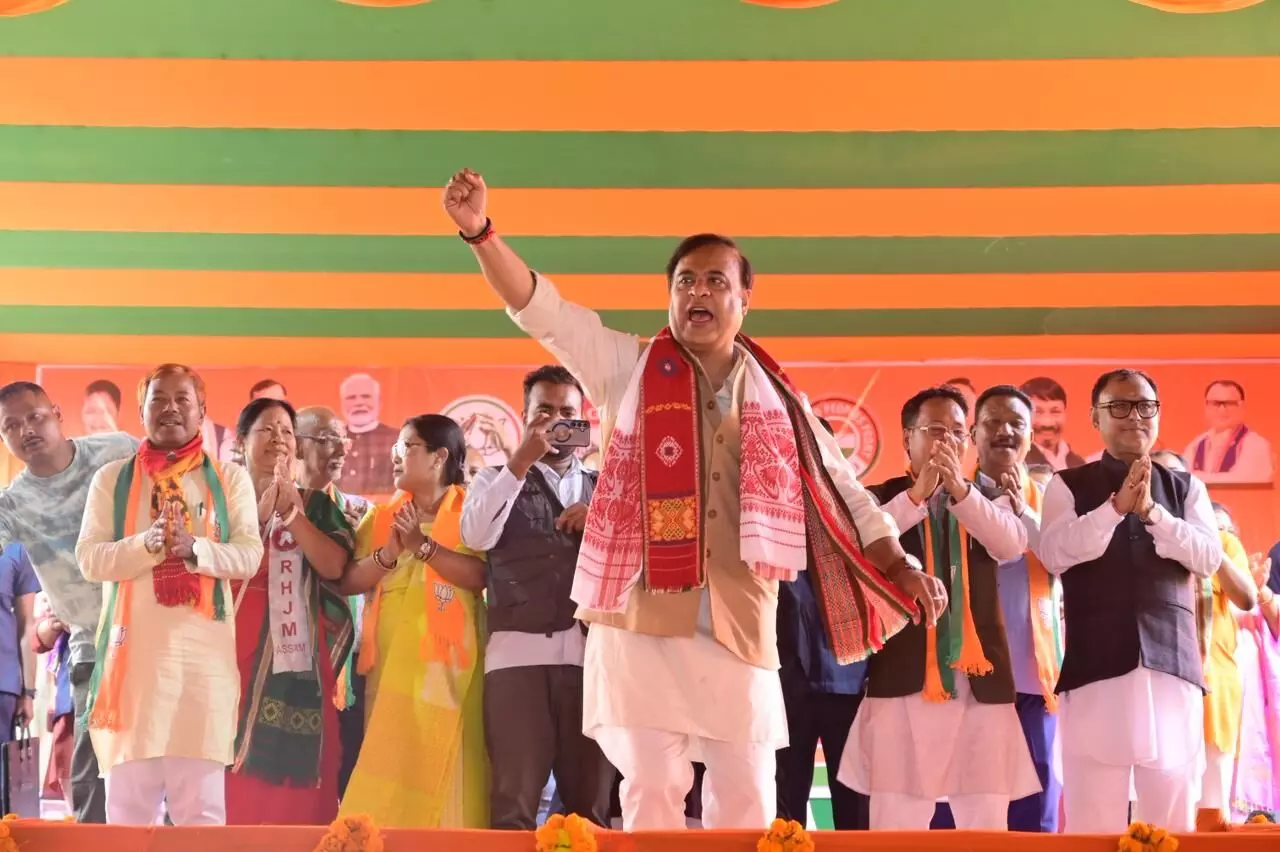
CM Sarma during a campaign meeting on Sunday. (Photo:@himantabiswa/X)
Guwahati, April 8: From personal allegations to identity flashpoints and the rise of new political faces, the run up to 2026 Assam Assembly election has been shaped by a series of headline-grabbing events and personalities that have defined the campaign far beyond conventional issues.
Though a serious policy debate was entirely missing, there was no dearth of social-media reel material from either side.
Passport row dominates final phase of campaigning
Though it surfaced only at the fag end of campaigning, the controversy surrounding Chief Minister Himanta Biswa Sarma’s wife Riniki Bhuyan Sharma quickly became the biggest flashpoint of the election.
Triggered by allegations from senior Congress leader Pawan Khera alleging that the CM’s wife was holding multiple foreign passports and offshore property, the issue escalated rapidly into FIRs, counter-complaints and sharp political exchanges.
The BJP dismissed it as a “baseless smear-campaign”, with Sarma announcing that all the documents produced by the Congress were fake, AI generated.
But, the row ensured that the campaign’s closing stretch was dominated by personal attacks rather than policy debates.
Beef politics returns to centre stage; triggers debate
Before the passport issue took over, the election had already witnessed a sharp turn with the beef controversy, particularly in Guwahati Central.
Sarma publicly targeted AJP candidate Kunki Chowdhury and also her mother over alleged social media posts linked to beef consumption.
The remarks triggered a strong counter from Choudhury and opposition leaders, turning the issue into a wider debate on the level of politics.
The controversy amplified on social media with the emergence of a morphed AI video of the AJP candidate, against which she filed a police complaint.
Turncoats reshape political equations
Equally significant has been the prominence of high-profile political shifts. Leaders like Pradyut Bordoloi and Bhupen Kumar Borah switching to BJP remained central in the initial political debates.
At the same time, the switchover of Cabinet Minister Nandita Garlosa following denial of a ticket by the BJP highlighted internal dissent within parties.
All parties like BJP, AGP, Congress, AJP welcoming the leaders of other parties with open arms and party tickets, gave rise to dissent within each party.
Jayanta Kumar Das, denied ticket from Dispur, entered the contest as an Independent and created a buzz openly criticizing BJP. The BJP expelled nine of its members, including him for anti-party activities.
New entrants to politics outshine veterans
Amid all this, it is the new entrants who arguably made the most news. Faces like Dr Gyanashree Bora and Kunki Chowdhury consistently dominated public conversations, often overshadowing established leaders.
Their rise points to a subtle but significant shift in Assam’s political landscape – where visibility, relatability and narrative-building get attention. Dr Bora of Raijor Dal captured much of public attention with her eloquence. Similarly, as a young, educated Kunki Chowdhury, rather new in politics, immediately found public support.
Identity faultline sharpens in Guwahati Central
The Guwahati Central constituency emerged as a microcosm of this shift. The contest between BJP’s Vijay Kumar Gupta and AJP’s Kunki Chowdhury quickly moved beyond numbers to narratives. The campaign here saw a sharp Assamese versus non-Assamese debate, further intensified by the beef controversy.
Questions of identity, belonging and cultural representation dominated public discourse, making the constituency one of the most closely watched.
Sivasagar contest fuelled ULFA-linked debate
In Upper Assam, the Sivasagar seat generated significant attention due to the candidature of Kushal Dowari.
His past association with the banned outfit United Liberation Front of Asom became a major talking point, particularly on social media.
This, despite the fact that Dowari has already represented Thowra in the State Assembly in 2006 and 2016.
Supporters framed his journey as one of reintegration into mainstream politics, while critics came up with his several alleged ‘past stories’, heating up the political environment.
Both major alliances had a tough job to handle
Interestingly, both the NDA and Congress-led Opposition alliance took time in choosing partners. NDA dumped its former alliance partner UPPL and re-inducted the Hagrama Mohilary-led BPF in the BTR. Of the 15 BTR Assembly seats, BJP gave 11 to BPF and fielded its four candidates in the region.
Congress too, prolonged its decision on whether to take Akhil Gogoi within the Opposition alliance fold. Finally, Gogoi negotiated 11 seats in the alliance and fielded another two candidates in a ‘friendly fight’.
An election powered by moments, not just manifestos
As Assam stands on the cusp of polling, one thing is evident: this has been an election defined less by manifestos and more by moments.
From passport to beef, from defections to identity, the 2026 contest has played out like a relentless narrative battle. And in that battle, those who made the most noise, had the maximum visibility.