
Multi-domain ops now crucial as threats blur borders: Air Marshal Dixit
From drones to cyberattacks, hybrid threats blur peace & conflict, says Dixit, urging coordinated response
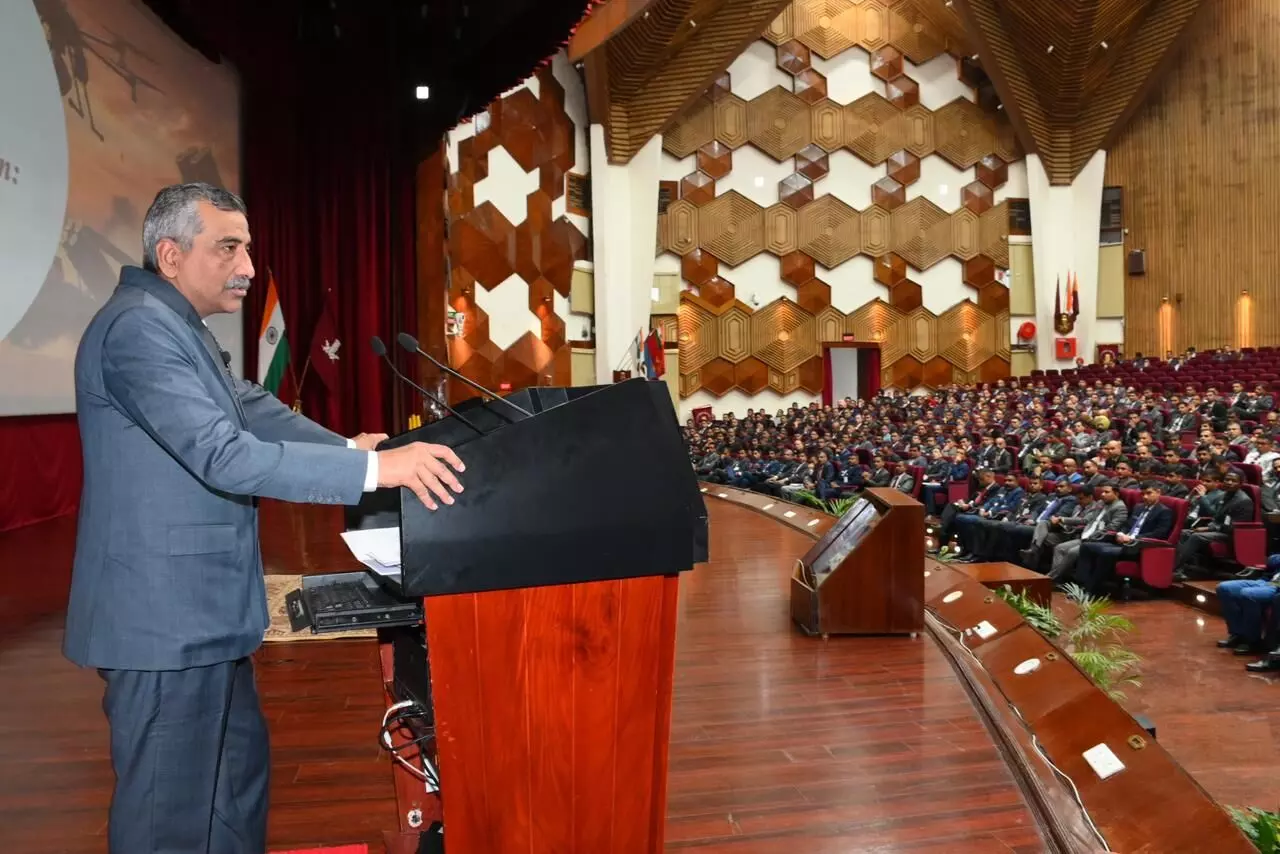
A file image of Air Marshal Ashutosh Dixit addressing a gathering at the Defence Services Staff College. (Photo:@PIB_India/X)
Bengaluru, Apr 9: Chief of Integrated Defence Staff Air Marshal Ashutosh Dixit, on Thursday, said India's environment makes the transformation towards Multi-Domain Operations (MDO) urgent, as the country faces threats that do not respect domain boundaries.
Asserting that preparedness must be multi-domain from the outset, he said that MDO is not a future option, but a present imperative.
"India's environment makes this transformation urgent - not aspirational. We face threats that do not respect domain boundaries," Dixit said, delivering the keynote address at the second edition of "Ran Samwaad 2026", with a theme "Multi-Domain Operations: An Imperative for Addressing Conventional and Irregular Threats."
Noting that along our northern borders, surveillance drones, satellite monitoring, electronic warfare, and rapid force mobilisation coexist in a state of permanent readiness, he said that in the maritime domain, sea lines of communication intersect with space-based surveillance, undersea competition, and carrier-based power projection.
According to him, the threat is evolving with each passing day on the western borders. Hybrid threats - misinformation campaigns, cyber intrusions targeting power grids, drone swarms over sensitive installations - deliberately blur the line between peace and conflict.
"These threats cannot be addressed by one service. They cannot be addressed sequentially. They must be addressed simultaneously, across domains, in a synchronised coordinated response."
On the ongoing West Asia conflict, he said it is a sharp reminder that sea lane disruption, energy supply shocks, and regional instability can affect India's interests without a single adversary targeting us directly.
"Preparedness must be multi-domain from the outset. That is why MDO is not a future option. It is a present imperative," he stressed.
Observing that multi-domain operations are not cosmetic jointness of three services talking to each other at conferences and meetings but planning separately, Dixit said that true MDO is architectural.
“It requires force structures, command relationships, data standards, training pathways, and industrial ecosystems to be built for interoperability from the very start. It is about thinking in terms of systems rather than platforms, effects rather than service equities, and speed of decision rather than tradition," he said.
"In short: MDO is not about what we own. It is about what we can do together - faster than the adversary," he added.
Pointing out that India's own experience with Operation Sindoor in May 2025 underscored, sharper than any doctrine document ever could, Dixit said that jointness is the need of the hour.
“Integrated operations, coordinated across services and domains in real time, define the new standard. That lesson must now be embedded into how we train, how we equip, and how we fight,” added.
The proliferation of drone technology across modern battlefields deserves special mention, Dixit said adding from Eastern Europe to West Asia, relatively low-cost unmanned systems, when integrated effectively, have changed the calculus of conflict.
PTI