
As crorepatis crowd Assam polls, a Bokakhat Independent opts for crowdfunding
Pranab Doley, runner-up in 2021 with over 27,000 votes, returns with grassroots-driven, people-funded campaign model this time
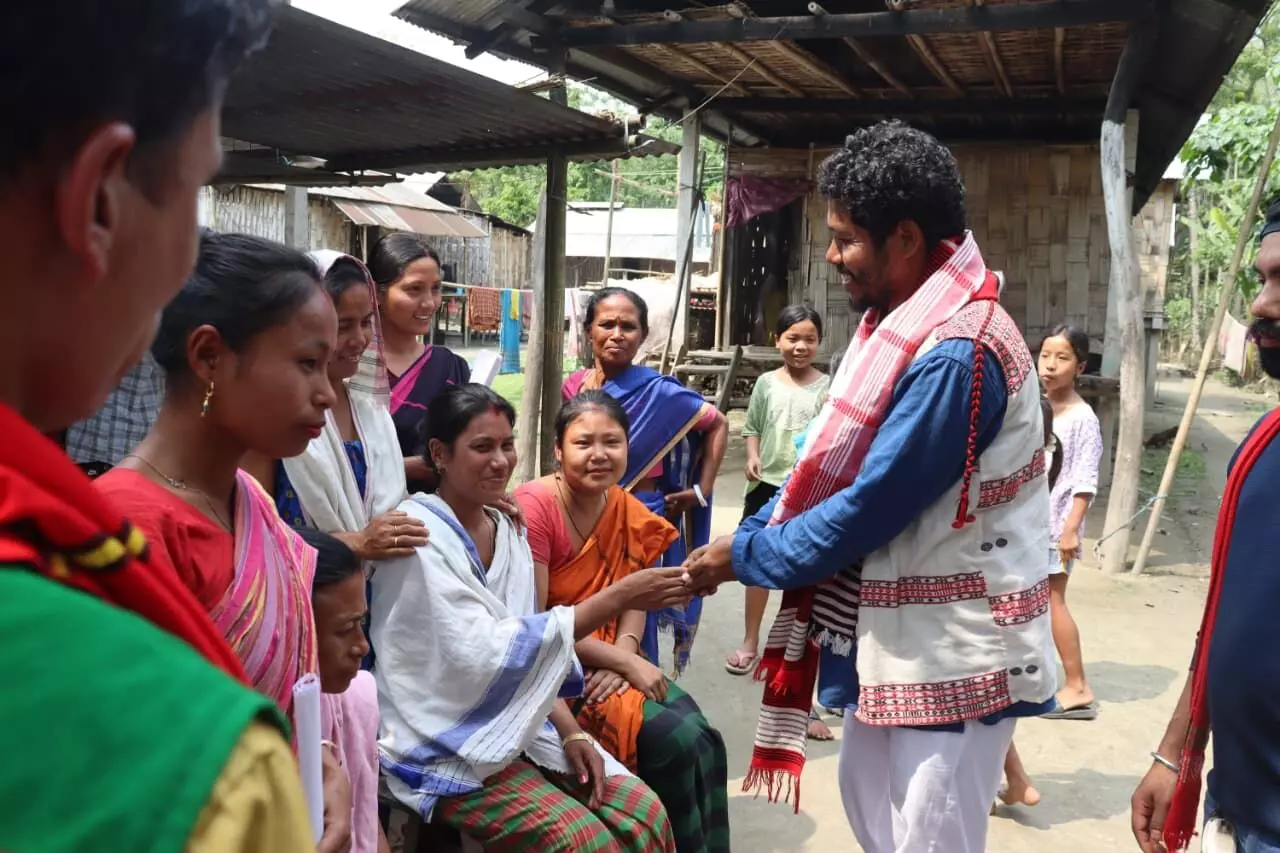
Pranab Doley during a door-to-door campaign. (AT Photo)
Guwahati, April 2: Money power is tightening its grip on Assam’s electoral landscape, with nearly 39% of the 722 candidates in the 2026 Assembly polls declared crorepatis, according to data from the Association for Democratic Reforms (ADR).
This marks a sharp rise from 28% in 2021, reflecting the growing financial muscle in the fray. Against this backdrop, Bokakhat independent candidate Pranab Doley is attempting to chart a different course, driven not by wealth but by people.
Doley, who secured 27,749 votes in the 2021 elections to emerge as the runner-up, has positioned his campaign as a people-driven movement, relying on crowdfunding and grassroots support.
His campaign highlights issues such as land rights, climate change, and the challenges faced by indigenous communities, farmers and tea garden workers.
“This election is not just about winning a seat. It is about protecting our land, our dignity, and our future,” a campaign note states, adding that the movement represents “a truth that cannot be bought”.
Unlike candidates backed by major political parties, Doley’s campaign openly acknowledges the financial constraints of contesting elections without institutional support.
Contributions are being mobilised through crowdfunding platforms, UPI payments and direct bank transfers, signalling a transparent and participatory funding model.
Doley’s campaign in-charge, Saurav Patgiri, argued that Doley’s independent candidature represents a rare alternative in a system dominated by party structures and financial muscle.
“Today, he is perhaps the only independent candidate consistently working on issues like land rights and climate change. Contesting elections without party backing is extremely difficult due to limited financial resources, while established parties have far greater funding,” Patgiri said.
Highlighting the nature of the campaign, he added, “This is a people-funded movement. The crowdfunding effort itself sends a message that politics can still be driven by grassroots participation rather than money power.”
Explaining the nature of the crowdfunding model and the support Doley has garnered, Patgiri said the concept extends well beyond monetary contributions.
“The youth and villagers from nearby areas have offered significant support. From running kitchens for campaign workers to meeting basic needs, people have stepped forward to help,” he said.
He added that the scale of spending by major political parties stands in stark contrast. “The cost of a single day’s campaign for well-funded candidates is equivalent to our entire campaign budget. Many parties would find it hard to believe that campaigning today can be done with such minimal funds,” he said.
Over the past five years, Doley and his supporters have worked at the grassroots to uplift marginalised tribal communities in the constituency.
From organising the Kaziranga People’s Festival to sustained activism, his work has centred on issues affecting residents of Bokakhat and the Kaziranga region.
With academic training from Visva-Bharati University and TISS Mumbai, along with years of organisational leadership and international representation of indigenous communities, including at the United Nations, Doley has emerged as a credible political voice from the region.
Patgiri also expressed disappointment over the lack of support from Opposition alliances.
“Despite securing over 27,000 votes in 2021 and emerging as the main opposition candidate in the constituency, he was not recognised or backed. There are also underlying concerns about representation and inclusivity that cannot be ignored,” he said.
Drawing a comparison with the 2021 elections and the trajectory of anti-CAA leaders in the state, Patgiri adds, “In 2021, three prominent anti-CAA leaders, namely Akhil Gogoi, Lurinjyoti Gogoi and Pranab Doley, emerged from mass movements. While the first two transitioned into party politics, Doley chose to remain a grassroots leader.”
As major parties field well-resourced candidates, including those aligned with ruling coalitions, Doley’s campaign raises broader questions about accessibility and equity in electoral politics.
In an election increasingly defined by financial strength, his experiment with crowdfunding may test whether grassroots mobilisation can still compete with mainstream politics.